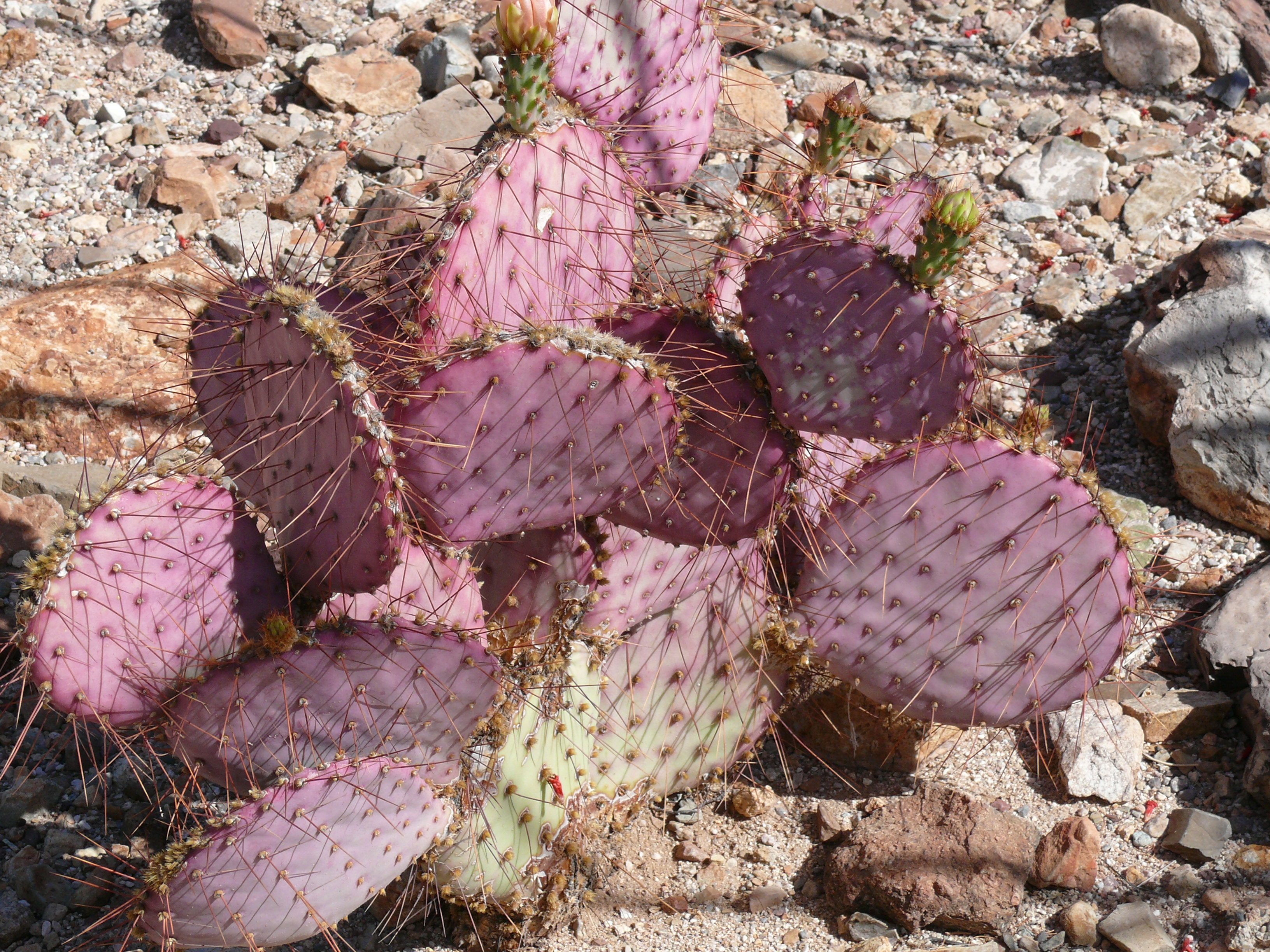
 Sue in az · CC BY-SA 3.0
also Purple prickly pear
Santa-Rita prickly pear
Opuntia santa-rita
- Family:
- Cactaceae
- Elevation:
- 2,000 ft – 4,500 ft
- Bloom:
- Apr – Jun
- Region:
- Southwest
A striking upright prickly pear whose round blue-gray pads flush vivid purple to lavender under cold and drought stress. Bright yellow spring flowers against the purple pads make it a prized ornamental of the Sonoran and Chihuahuan borderlands.
Care · tuned to the Southwest
Water
Very drought tolerant; occasional deep watering in the growing season intensifies growth, but overwatering causes rot and mutes the purple. Keep dry in winter.
Sun & exposure
Full sun and reflected heat; strong light and stress are what deepen the signature purple.
Soil
Sharp-draining sandy, gravelly, or rocky soil; poor drainage leads to pad rot.
In the Southwest
A warmer low-to-mid-elevation species, hardy to roughly 10–15°F. Pads carry sparse but sharp spines near the top plus irritating glochids. The purple is a stress response that fades in mild, well-watered conditions. Propagates easily from callused pads.
Common problems & fixes
Faded color — pads stay green instead of purple
Fix — Give more sun and reduce water; the purple is a stress pigment that intensifies with drought and cold.
Basal/pad rot from overwatering
Fix — Withhold water, ensure gritty fast-draining soil, and cut away any mushy tissue to clean green.
Pets & toxicity
Not chemically poisonous; the hazard is physical — sharp spines and barbed glochids that embed in mouths, paws, and skin.
Easy to confuse with
- Beavertail (Opuntia basilaris) — lower, glochid-only pads with magenta (not yellow) flowers
- Opuntia macrocentra — similar purple pad but with longer dark spines
Sources
Think you're looking at one?
Snap a photo and we'll rank the candidates against the local flora — honestly, and for free.
Identify a plant