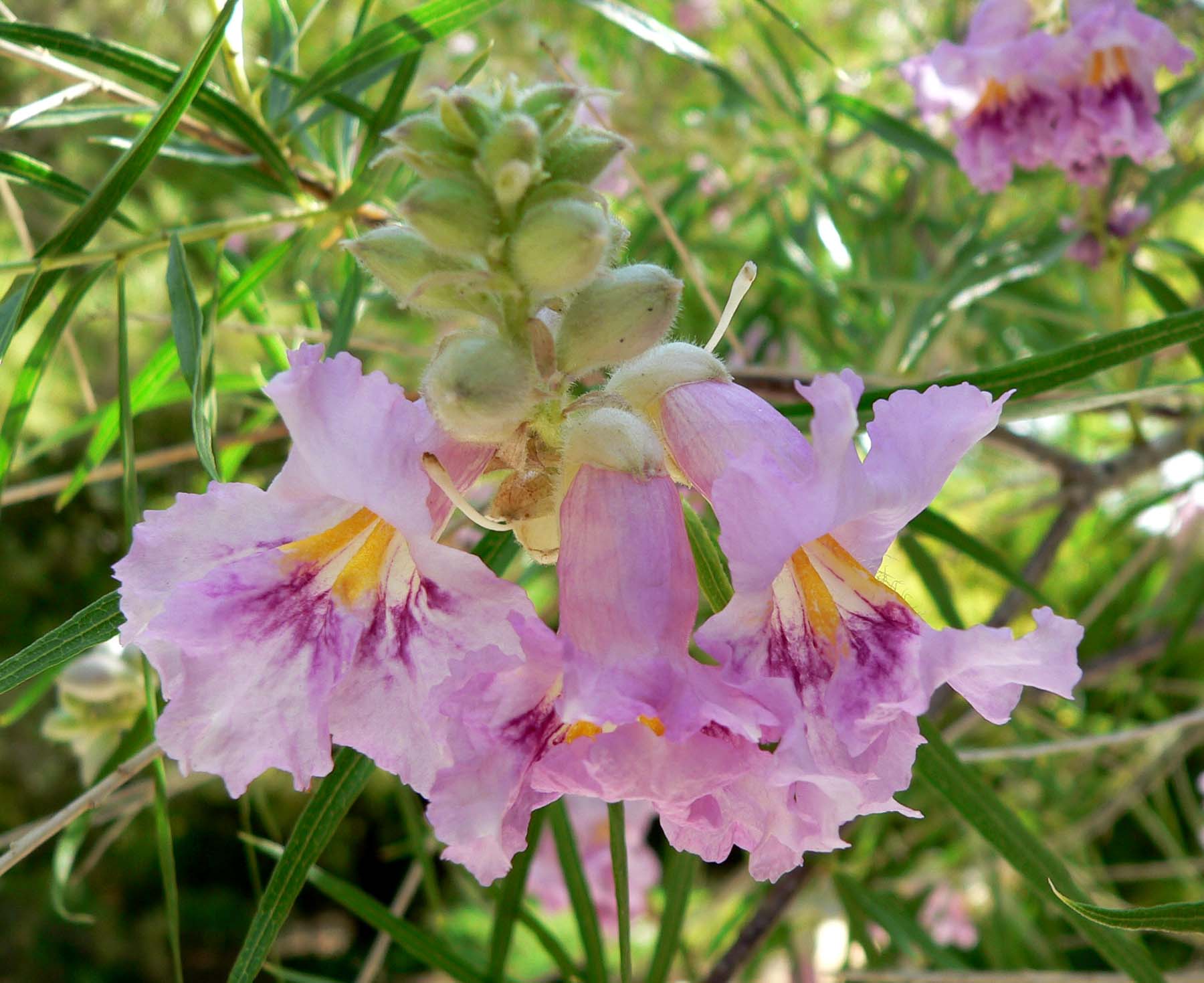
 Stan Shebs · CC BY-SA 3.0
also Flowering willow
Desert willow
Chilopsis linearis
- Family:
- Bignoniaceae
- Elevation:
- 1,500 ft – 5,500 ft
- Bloom:
- May – Sep
- Region:
- Southwest
Not a true willow — a small desert tree with willow-like leaves and orchid-shaped pink-to-burgundy trumpet flowers that hummingbirds work all summer. A signature of washes and low-elevation NM landscapes.
Care · tuned to the Southwest
Water
Deeply drought tolerant but blooms far more with a deep soak every 2–3 weeks in summer. Do not keep it constantly wet — it defoliates and gets leggy.
Sun & exposure
Full sun; anything less and it barely flowers.
Soil
Sandy or gravelly, sharply drained. Naturally found in arroyo bottoms, so it takes occasional flooding but not standing water.
In the Southwest
Deciduous and slow to leaf out — often bare until late April/May, which alarms new growers. Prune in winter to lift into a small multi-trunk tree. Marginal above ~5,500 ft where hard freezes bite back young wood.
Common problems & fixes
Aphids and sooty mold — aphids on new growth, then black mold on the honeydew
Fix — Blast them off with a strong water spray or use insecticidal soap, which also clears the mold.
Chlorosis from overwatering — leaves yellow when the soil stays too wet
Fix — Cut back irrigation and ensure sharp drainage; water deeply but infrequently.
Weak, leggy, suckering structure — fast growth makes a floppy multi-stem mess
Fix — Prune in winter dormancy to build strong scaffold branches and remove basal suckers.
Pets & toxicity
No known toxicity to pets.
Easy to confuse with
- True willows (Salix) — riparian, no trumpet flowers
- Chitalpa — hybrid, larger leaves, sterile
Sources
Think you're looking at one?
Snap a photo and we'll rank the candidates against the local flora — honestly, and for free.
Identify a plant