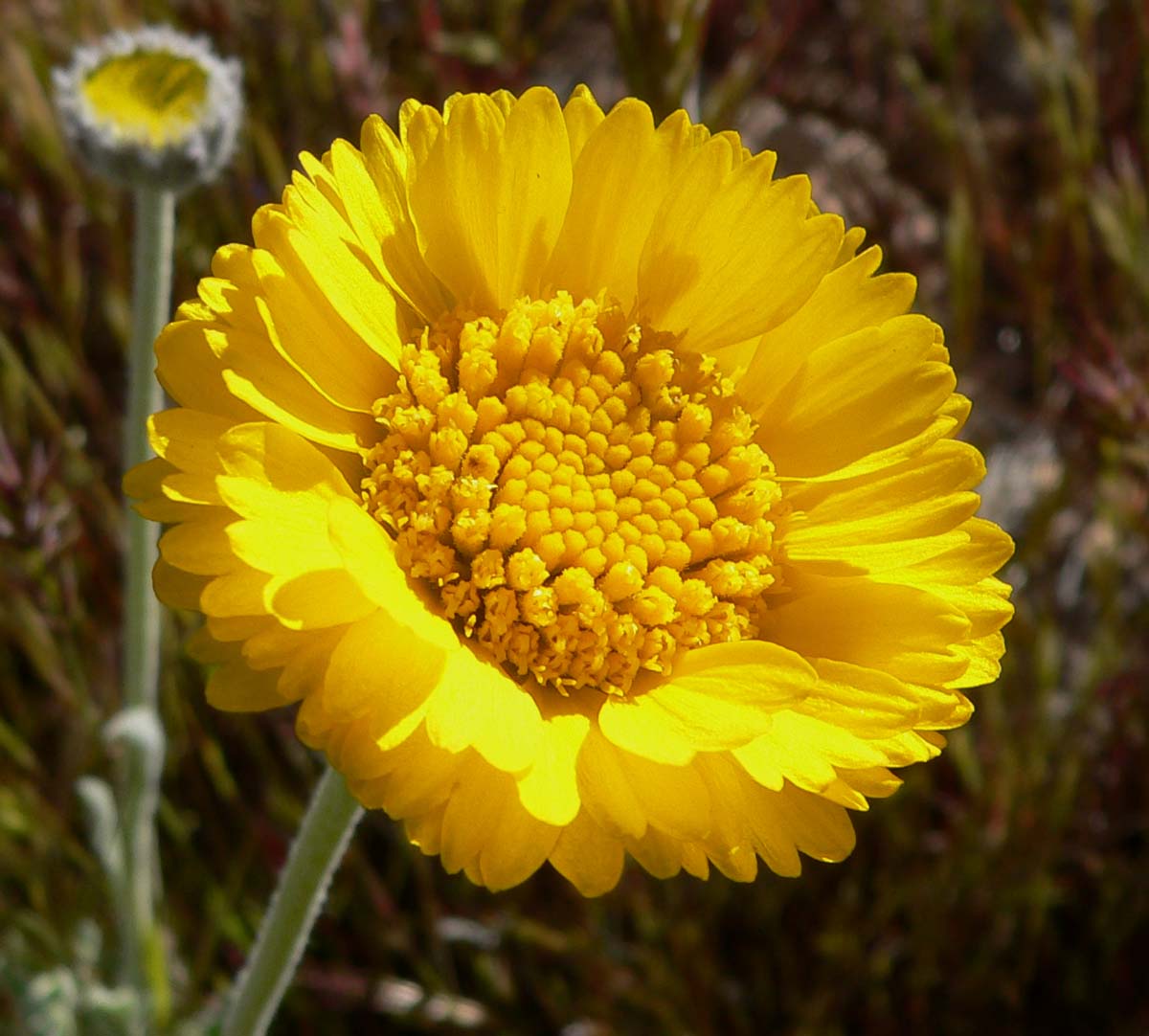
 Stan Shebs · CC BY-SA 3.0
also Paper daisy
Desert marigold
Baileya multiradiata
- Family:
- Asteraceae
- Elevation:
- 2,000 ft – 5,500 ft
- Bloom:
- Mar – Oct
- Region:
- Southwest
A short-lived mound of woolly gray-green foliage that floats bright lemon-yellow daisies on slender stalks for much of the warm season. A tough, self-seeding wildflower that lines desert roadsides after rains.
Care · tuned to the Southwest
Water
Very drought tolerant; blooms on rainfall alone but flowers longer with occasional deep watering. Overwatering shortens its life and invites rot; it self-sows readily to persist.
Sun & exposure
Full sun; handles heat and reflected exposure with ease.
Soil
Wants sandy, gravelly, alkaline, sharply drained soil; tolerates poor and disturbed ground and dislikes rich, moist beds.
In the Southwest
Behaves as a short-lived perennial or reseeding annual, so let some seed heads mature to keep a stand going. Deadheading extends bloom. Attractive to native bees and butterflies. Foliage has been reported as toxic to livestock (notably sheep) if grazed heavily.
Common problems & fixes
Short-lived and rots with too much water — dies out in irrigated or heavy soil
Fix — Give it lean, sharply drained soil and minimal water, and let it reseed to maintain a stand.
Leggy with fewer flowers in shade or rich soil
Fix — Site in full, hot sun, skip fertilizer, and deadhead spent stalks to prolong bloom.
Pets & toxicity
Reported toxic to livestock, especially sheep and goats, when grazed in quantity; keep pets from consuming large amounts.
Easy to confuse with
- Brittlebush (Encelia farinosa) — woody shrub with resinous stems
- Paperflower (Psilostrophe spp.) — flowers dry and persist papery on the plant
Sources
Think you're looking at one?
Snap a photo and we'll rank the candidates against the local flora — honestly, and for free.
Identify a plant